1. Count the work still left
List the remaining hours for each accepted commission, including agreed revisions, finishing and export. Leave out hours you have already completed. Keep the new request separate until you have checked it.
2. Use your real available hours
Enter the time you can work each day after your job, admin and other commitments. Use zero for days off. Deduct a reserve that suits your circumstances; the 20% below is an illustration, not an industry rule.
3. Check every deadline
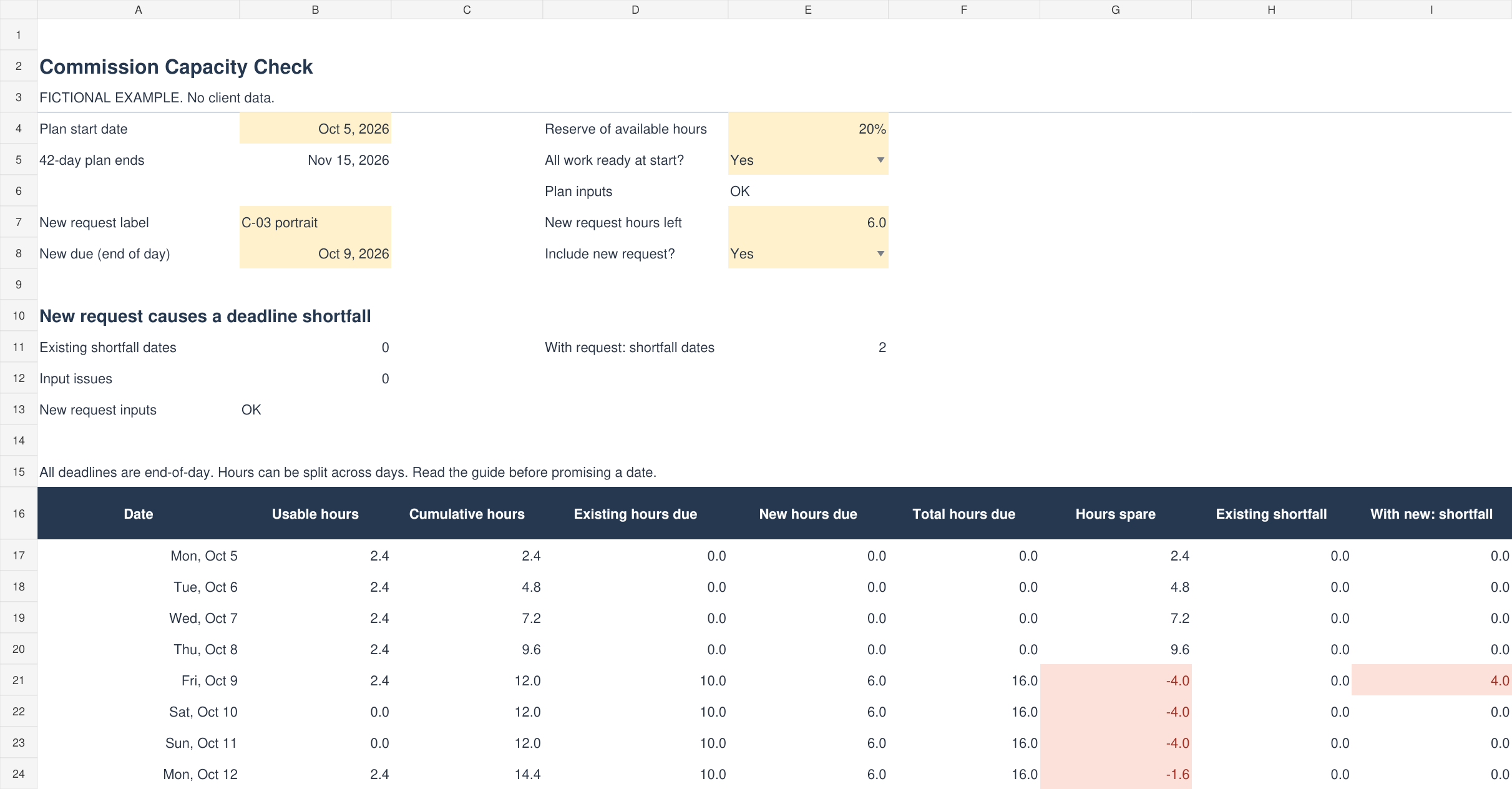
Imagine you start on October 5, 2026 and can work three hours each weekday, with weekends off. After a 20% reserve, each working day contributes 2.4 usable hours.
You already owe a 10-hour icon project by October 9 and a 12-hour banner by October 16. A new portrait needs six hours. The following totals are cumulative from October 5.
| Deadline | Usable hours | Hours due with portrait | Result |
|---|---|---|---|
| Oct 9 | 12 | 16 | 4 hours short |
| Oct 16 | 24 | 28 | 4 hours short |
| Oct 20* | 28.8 | 28 | 0.8 hours spare |
*The last row is a different scenario: move the portrait deadline to October 20 and recheck all earlier commitments. Dates and hours are fictional, not typical artist workloads.
Moving the portrait only one week does not solve this example. By October 16, the two accepted jobs already need 22 of your 24 usable hours. Adding six more still leaves a four-hour gap.
4. Change the plan, then check again
Moving the new portrait to October 20 clears the arithmetic in this example. But taking October 20 off removes 2.4 usable hours and leaves a 1.6-hour shortfall. Update your available time whenever your circumstances change.
A negative gap calls for a concrete change: a later date, a smaller agreed scope, or declining the request. Do not count on unplanned overtime to make a promise look possible.
What this calculation cannot decide
This method assumes all work is ready to begin at the plan start, one person does it, and hours can be split across days. Plan client approval waits, task dependencies, fixed appointments, drying and shipping separately. Enough total hours is not a guarantee of delivery.
Use the free worksheet with your own remaining-work estimates. For occasional commissions, a calendar and this manual check may cover what you need.